
Unlocking the trapped value of AI:Are you solving for the wrong problem?
Author: Scott Vincent, CEO, Digital Futures
Trillions in AI value remain trapped inside organisations that have the technology but lack the workforce capability to use it. Close that gap through AI fluency, applied skills, and embedded governance, and AI’s promise of economic transformation moves from theory to reality.
Artificial intelligence (AI) has reached an inflection point. Models are more capable than ever, investment is at record levels, and the technical infrastructure is in place.
And yet across sectors, the returns remain underwhelming.
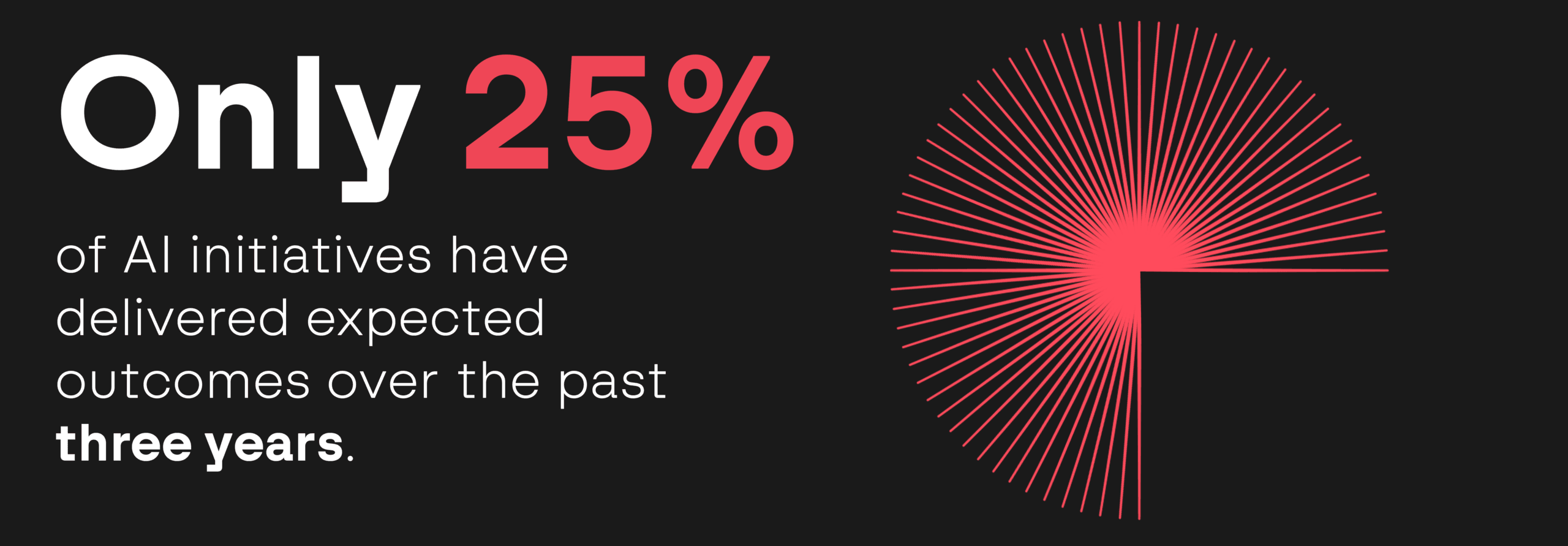
In spite of significant investments, most large organisations are not seeing meaningful economic impact from AI. One report found that only 25% of AI initiatives have delivered expected outcomes over the past three years, and just 16% have scaled enterprise wide; another revealed that only 39% of organisations report any measurable effect on EBIT from AI. In financial services alone more than 80% of firms are deploying AI, but only 14% report any strategic impact.
Meanwhile, AI is projected to contribute more than $19 trillion to the global economy by 2030, driven by productivity gains and business transformation. The World Economic Forum (WEF) projects that AI along with other technology shifts could drive the creation of 170 million new roles by 2030, while triggering the disruption of 44% of core skills within five years.
The tension is now explicit: unprecedented investment and potential, but weak and uneven value capture. The transition to an AI-first operating model is not a distant scenario but operational reality. Yet most organisations are struggling to make the shift from pilots to scale.
The question isn’t whether AI can deliver; it’s why its value remains trapped.
The answer, in my view, is unambiguous: the limiting factor is no longer technology. It is workforce capability.
The Root Cause of AI Failure?It’s not the AI
The Stanford Digital Economy Lab recently examined 51 companies that are deploying AI at scale. Their Enterprise AI Playbook found that failure rarely originates from model performance or technical limitations. Instead, it comes from the inability to redesign internal processes, organise data effectively, and fundamentally shift how the organisation operates.
It’s something I hear in my conversations with our clients and it’s what our own people are seeing every day. AI fluency drives adoption, and adoption creates value. Hundreds of Digital Futures consultants are embedded inside leading global enterprises, helping them to adopt and deploy AI, and build internal AI capacity to generate returns. Organisations have made significant AI infrastructure investments, but the workforce – from the frontline to the boardroom – often lacks the fluency, skills, and strategic alignment to translate that investment into measurable productivity gains and value.
"The most valuable insights about AI adoption are not in hypotheticals or predictions. They are in the patterns of those who have already walked the path."
Enterprise AI Playbook
Stanford Digital Economy Lab
Across enterprises, AI capability remains invisible: fragmented across teams, uneven in maturity, and ungoverned. There is no clear baseline of workforce readiness for AI, limited ability to integrate AI into core workflows, and insufficient visibility into where it can drive meaningful gains. Critically, most are not equipped to evidence the governance, oversight, and compliance to satisfy boards, investors, and regulators.
This challenge spans every level. Executives are under pressure to lead the transition to an AI-first business, while demonstrating both impact and control. Yet most are navigating a landscape of competing hype and incomplete intelligence, without the data-driven frameworks required to make sound strategic decisions.
Across the wider workforce, the challenge is different but equally acute. Not everyone needs deep AI expertise, but everyone needs specific skills to apply it effectively in their role. And because those requirements vary widely by function and level, identifying capability gaps and mapping targeted development is inherently complex.
At the same time, the compliance environment is tightening as regulators desperately try to catch up with rapidly evolving technology. Frameworks such as the EU AI Act and the NIST AI Risk Management Framework are formalising new obligations for AI literacy, governance, and responsible deployment. In this context, scaling AI without the ability to demonstrate trust, security, and assurance is not innovation; it is unmanaged risk.
Workforce capability and AI governance have thus become core infrastructure. Scaling AI now depends on what sits beneath the technology: ensuring people and teams have the right level of AI fluency and provable governance to enable the organisation to adopt AI safely and profitably.
The Missing AI Infrastructure:Capability and Governance
Closing the gap between AI activity and enterprise value means treating workforce capability as a measurable, managed asset and embedding AI governance that can adapt to still evolving technology and regulatory requirements.
This is the challenge Digital Futures was built to solve.
We partner with global enterprises and governments to build enduring AI workforce capability and strengthen compliance with evolving regulatory requirements so they can accelerate their transformation to an AI-first organisation and operating model.
At the heart of our platform is Athena AI™: a system of record for AI capability and governance. It provides a real-time, quantified view of workforce AI capability across roles and functions. It maps skills to workflows, generates enterprise intelligence on adoption and performance, and enables organisations to demonstrate governance and oversight. In short, Athena AI™ makes AI capability visible, measurable, and governable at scale. It is the intelligence layer that connects AI investment directly to workforce readiness, productivity outcomes, and regulatory compliance.
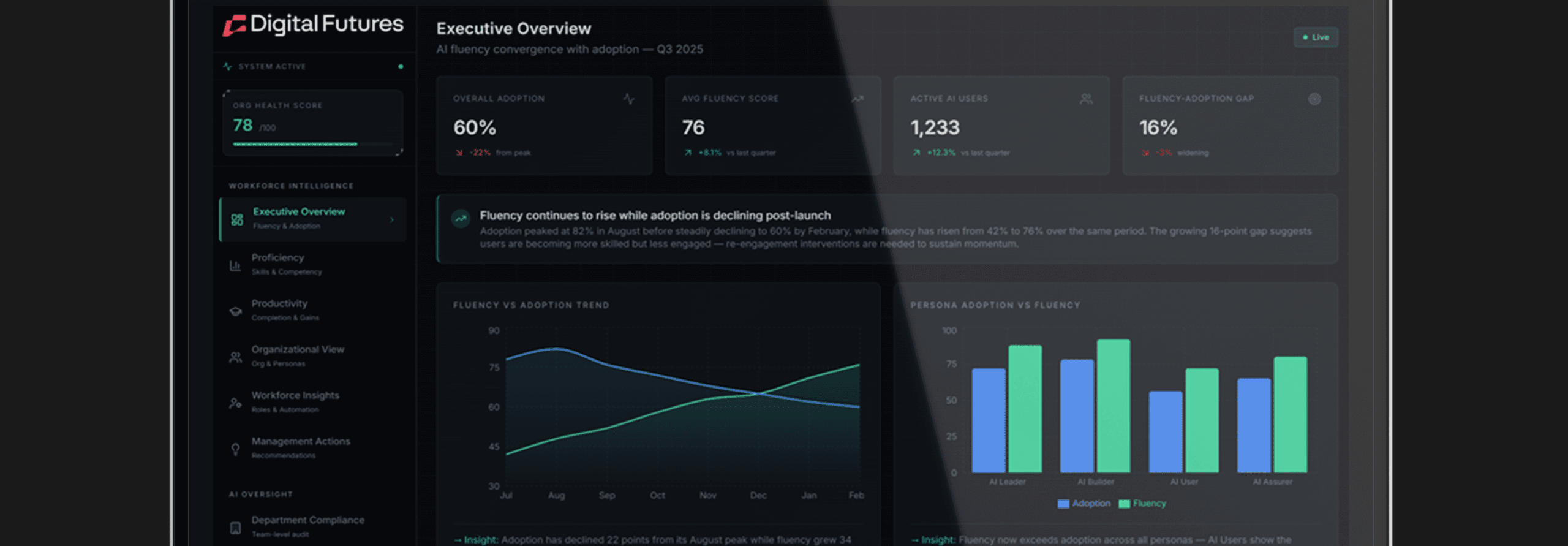
Alongside Athena AI™, our Frontier AI capability deployment engine embeds AI engineers and data specialists directly into client organisations, building and scaling AI systems while transferring capability to internal teams.
Unlocking AI’s Trapped ValueStarts with Human Capability
The twin strategic imperatives of our time are Sovereign AI and the transition to AI-first operating models. And both share the same bottleneck: human capability.
This isn’t a technical challenge; it’s a human one.
Organisations and countries that build AI capability at speed and at scale will lead the next wave of economic growth, powered by an engaged, capable, and future-ready workforce.
That means cultivating the skills, governance maturity, culture, and leadership capacity required to translate technology into real economic and social value.
The capability gap is real, but it is also solvable.
Organisations that invest now in their workforce AI fluency, applied skills, and governance will be the ones that finally unlock AI’s value. The transformation promised by AI is within reach for those who focus on the right problem.
Want to learn more? Let us show you how we’re helping our clients build the strategic workforce capability to lead in the age of AI and creating opportunity at scale for inclusive growth, productivity, and lasting social impact. Contact us to book a demo today.